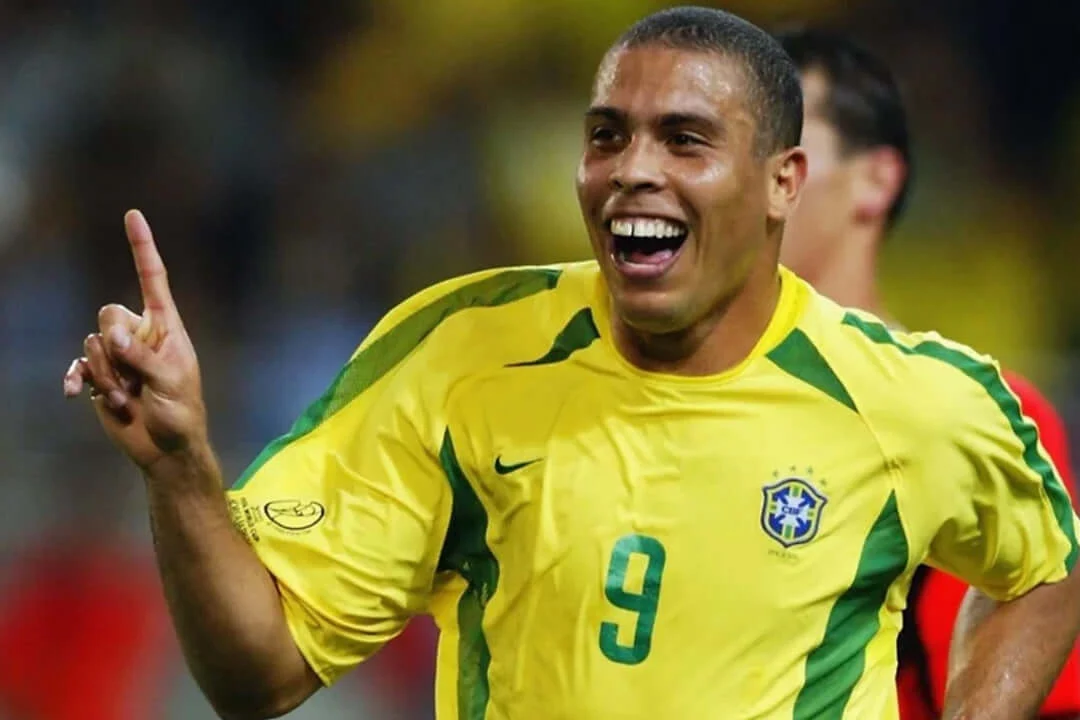
Ronaldo Luís Nazário de Lima, widely known as Ronaldo Nazário or “O Fenômeno”, is one of Brazil’s most famous footballers. Born in Rio de Janeiro in 1976, he began his professional career with Cruzeiro, where his exceptional goal-scoring ability quickly attracted international attention.
At just 17, Ronaldo moved to PSV Eindhoven in the Netherlands. He scored 52 goals in 56 games for PSV, establishing himself as one of the most exciting young forwards in world football.
He later played for Barcelona, Inter Milan, Real Madrid, AC Milan, and Corinthians. His career was affected by serious knee injuries, particularly during his time at Inter Milan, but he successfully returned to the highest level of football.
Ronaldo’s greatest international moment came at the 2002 FIFA World Cup. He scored 8 goals, including both goals in Brazil’s 2–0 victory over Germany in the final, helping Brazil win its fifth World Cup.
He finished his Brazil career with 62 international goals in 98 appearances.
Ronaldo Nazário’s Highest Goal Records
- ⚽ Brazil: 62 international goals in 98 appearances.
- 🏆 FIFA World Cup: 15 goals in 19 matches across four World Cups.
- 🥇 2002 World Cup: 8 goals, winning the Golden Boot.
- 🇪🇸 Real Madrid: 104 goals in 177 official matches.
- 🇳🇱 PSV: 52 goals in 56 games.
- 🏅 Ballon d’Or: Winner in 1997 and 2002.
Ronaldo Luís Nazário de Lima, widely known as Ronaldo Nazário, R9, or “O Fenômeno,” is one of the most famous Brazilian footballers of his generation. Born on September 18, 1976, in Rio de Janeiro, Brazil, Ronaldo became renowned for his explosive speed, close control, powerful finishing, and ability to score from difficult positions. He played primarily as a striker and became one of Brazil’s most celebrated football stars.
Ronaldo began his professional career with Cruzeiro in Brazil during the early 1990s. His exceptional goal-scoring ability quickly attracted international attention. He scored 44 goals in 47 appearances for Cruzeiro before moving to Europe and joining PSV Eindhoven in the Netherlands. At PSV, he continued his remarkable scoring form, scoring 54 goals in 57 appearances according to career statistics reported by Goal.
His performances in the Netherlands led to a move to Barcelona in 1996. Ronaldo spent only one season at the Spanish club, but it became one of the most memorable campaigns of his career. He scored 47 goals in 49 games and established himself as one of the world’s most exciting young forwards.
In 1997, Ronaldo moved to Inter Milan. His combination of acceleration, dribbling, strength and finishing earned him the nickname “O Fenômeno,” meaning “The Phenomenon.” He won the Ballon d’Or in 1997 and became one of the most recognizable players in world football.
Ronaldo’s career was also affected by serious knee injuries. During his time at Inter Milan, he suffered major injuries that kept him away from football for extended periods. Despite these setbacks, he made a remarkable comeback and returned to the Brazilian national team for the 2002 FIFA World Cup.
The 2002 World Cup became one of the defining chapters of Ronaldo’s career. Playing alongside Brazilian stars such as Rivaldo and Ronaldinho, Ronaldo scored eight goals during the tournament. He scored twice against Germany in the final as Brazil won 2–0 and claimed its fifth World Cup title. Ronaldo finished the tournament as the leading scorer and won the Golden Boot.
After the 2002 World Cup, Ronaldo joined Real Madrid as part of the club’s famous Galácticos era. He scored 104 goals in 177 appearances for Real Madrid and won another Ballon d’Or in 2002. His time in Madrid included numerous memorable performances and goals.
Ronaldo later played for AC Milan and Corinthians before announcing his retirement from professional football in February 2011. Across his senior career, he scored 414 goals, including 352 at club level and 62 for Brazil.
For the Brazilian national team, Ronaldo scored 15 goals at the FIFA World Cup across the 1998, 2002 and 2006 tournaments. FIFA records him as Brazil’s leading World Cup scorer. His eight goals at the 2002 tournament remain one of the outstanding individual scoring performances in World Cup history.
Ronaldo’s football legacy is built not only on his goals and trophies but also on his comeback from serious injuries. His career combined extraordinary attacking talent, major international success and memorable performances for some of Europe’s biggest clubs.
Today, Ronaldo Nazário is remembered as R9 and “O Fenômeno,” a nickname that reflects the extraordinary impact he had on football during the 1990s and 2000s.
Follow us, like our page, and never miss a football update! ⚽🔥
QuickKeyPointers — Stay Updated. Stay Connected. Stay Football.
Leave a Reply